
In the shadow of the Himalayas, a new power ascends.
In this episode, Ewen tells the story of India. From the first humans to cross the mountain passes and enter the deep jungles, to the ancient origins of Indian philosophy and religion, the coming of Alexander, the Maurya and the Mughals, the East India Company, the Raj, and the modern world’s largest democracy: hear the tale of India as never before.
How has India’s ancient past shaped the country today? What are India’s strengths and weaknesses? And will this huge, vibrant country rise to become the world’s next great superpower?
Play the Episode:

Episode Script
The village of Ratnanagar sits on the bank of the East Rapti river as it curls westwards beneath the foothills of the mighty Himalayas. On the far side of the river lies a deep, dark jungle.
At sunset, the calls of colourful peacocks carry across the water as huge elephants and rhinoceros come carefully out from the trees. Langur monkeys sit and swing high in the branches. Below, black sloth bears shuffle through the leaves. The last light catches the blue wings of darting kingfishers. And in the shadows of the jungle, beneath the deep red of the setting sun, tigers move unseen.
Far in the distance the hills of this jungle begin to flatten out. Beyond lies a wide, fertile land of immense rivers, high deserts, deep forests, and bustling, teeming cities. It is a land that stretches over two thousand kilometres towards the equator, a land with an ancient and rich history, home to nearly a fifth of all humans alive today. This is the land of India.
The riverine ecosystems south of the Himalayas form some of the richest and most fertile places on Earth. They have long supported some of the wealthiest civilisations in history. When united, these civilisations wield immense power. But when they fracture, their vast wealth tempts those who live beyond the mountains.
My name’s Ewen Levick, and you’re listening to A History of the Future. Each episode I look at a country making headlines today, and go down into the history behind the news. I want to start at the beginning and ask, why do countries behave the way they do? What motivates them? What are their greatest needs? And what do they fear the most?
In this episode, I want to tell the long and ancient story of India. I want to tell of the rise and fall of its civilisations, explore the impact of its culture and history on the modern world, and ask where this country will go next. What are India’s greatest strengths? What are its weaknesses? And will it rise once again to become the 21st century’s next great superpower?
The story of India begins millions of years ago on a supercontinent we now call Gondwana. This was an enormous landmass, 100 million square kilometres in size, about a fifth of the entire surface of the Earth. But around 130 million years ago the Indian tectonic plate began to split from the east coast of what is now Africa.
The Indian plate began moving north at great speed. 55 million years ago it collided with Asia and pushed up the enormous mountains we know today as the Himalayas. The highest peaks of these mountains rise nearly 9000 metres into the sky, almost two kilometres higher than any mountain outside Asia. And they are still rising at around 5 millimetres per year.
From the foothills of the Himalayas, the Indian peninsula stretches thousands of kilometres southwards into the ocean. The geography of this subcontinent is varied, but it can roughly be split into North and South India.
In the north there is a vast flat land called the North Indian Plain. This is an area of 700,000 square kilometres stretching across the southern edge of the mountains, from the Iranian border in the west to what is now Bangladesh in the east. Several rivers run across this plain. The largest are the Indus River, in what is today Pakistan, and the Ganges, which flows eastwards for 2500 kilometres to reach the sea in modern day Bangladesh.
These rivers and their many tributaries carried loose clay, silt and sand from the mountains, which together form highly fertile alluvial soil. Over millions of years the North Indian Plain became the largest expanse of uninterrupted alluvium on Earth. As a result, these ecosystems had an extremely high carrying capacity for complex life forms – which as we will see, would later allow for an enormous human population.
In the south of the subcontinent, the old Gondwanan coast eroded into a mountain range that is now called the Western Ghats. These mountains block the clouds of the southwestern monsoon, which means the coasts of southern India are lush and green, while the lands beyond, called the Deccan Plateau, are semi-arid and rocky. Yet several large rivers rise on this plateau and flow eastwards, including the Godavari and the Krishna.
By around 55,000 years ago, modern humans arrived from the high passes of northwest. They displaced earlier hominids that lived in the deep jungles and dry rocky landscapes, including homo erectus, which stood around 5 feet tall and was the first known life form to use fire.
These first humans came in small family groups of perhaps a few dozen people. In the fertile river-lands, those families interacted and came to form larger populations, perhaps tribes of a few hundred. And there they survived for thousands of years amongst the wild creatures of the sub-continent, including rhinos, tigers, sambar deer, and importantly, elephants.
By around 6500 BC, agriculture appeared in the lost forests of what is today western Pakistan. Carvings and cave paintings dating from around this time show some of the earliest evidence of human interactions with elephants.
Adult male Asian elephants weigh in at around 4 tons, roughly the weight of eight to ten horses. Their brains contain a well-developed neocortex, enabling them to learn, and so these giants would soon become central to local trade, construction, agriculture, and warfare.
Over the next two thousand years these settlements spread through the Indus valley, at the western edge of the North Indian Plain.
The resulting civilisation became perhaps the largest in the world. Its people farmed sheep, goats and cattle.
They used boats to fish and to trade along the rivers and over the sea with the people of the Middle East. They produced copper, bronze, lead and tin. They produced written symbols that, sadly, we can no longer decipher. And by around 3000 BC, they built cities with docks and canals. Today they are known as the Indus Valley Civilisation, or the Harappan people.
The introduction of new crops, particularly rice from China, allowed Harappan civilisation to flourish. By 2000 BC settlements had spread along most major tributaries of the Indus river. Thanks to the high carrying capacity of these alluvial soils, this was likely the most populated place on Earth, rivalled only by the floodplains of eastern China, as we discussed in an earlier episode.
In around 1800 BC, Harappan civilisation began to collapse. It is not clear exactly why. What is known is that other nearby civilisations also began to collapse around this time, including the Sumerians in the Middle East, which suggests that a shift in monsoonal weather patterns may have devastated early agriculture.
Another explanation lies in the continued upward movement of the Himalayas. Upheavals in the Earth’s crust around this time abruptly shifted the flow of water in the Indus Valley. The Harappan did not use extensive irrigation, and so the movement of the Himalayas and the change of the monsoon likely caused the tributaries of the Indus River to dry out. The carrying capacity of these ecosystems suddenly fell. Those who did not starve became vulnerable to the spread of malaria, which is evident in skeletons dating from this time. And so early civilisation on the subcontinent faltered.
Over the next centuries, a new people followed the paths of the first humans into the northwest of the Indian subcontinent.
These newcomers spoke a language called Proto-Indo-European. This language first arose amongst the nomadic people of what is today southern Russia, as we discussed in an earlier episode.
The people who carried this language into the North Indian Plain were called the Arya. They walked amongst the ruins of the fallen Harappan civilisation and into the smaller settlements of its survivors. They settled in small villages amongst the abandoned brick cities, and they also moved further east, to the banks of the mighty river Ganges.
The impact of this migration is still evident today. Proto-Indo-European is the common ancestor of many modern Indian languages, such as Hindi, Bengali, and Punjabi, as well as European languages such as English, French and Russian.
The people of modern India speak over 300 different languages, but those belonging to the Indo-European family are found in the north and west, where the Arya first arrived. In the east and south, the dominant languages are those of the Dravidian family, which is unique to India.
This linguistic divide is mirrored in genetic evidence. India is home to the second most genetically diverse population on Earth, after the people of Africa. Yet the genetics of people with north Indian ancestry are closely related to populations in Central Asia, the Middle East and Europe, while the genetics of people with South Indian ancestry are unique to the subcontinent.
By the year 1500 BC, the people living around the Ganges first began to lay down written texts, mostly on the bark of birch trees. They did so in the ancient Indo-European language of Sanskrit. Their writings are known as the Vedas.
Over the next centuries, Sanskrit became the sacred language of the Vedic religion, based on the writings of the Vedas. This would later evolve into Hinduism, which is often described as the oldest religion on Earth.
Unlike later religions that emerged in the Middle East, such as Islam and Christianity, Hinduism encompasses a range of traditions that all follow the dharma, a cosmic order first described in the Vedas. For many Hindus, this is the dance of Shiva, the creator and the destroyer, who governs the tidal flow of all things; birth and death, growth and decay. It is also the power of Vishnu, who appears on Earth as the great heroes of Indian mythology, and who can preserve and hold this cycle at bay, at least for a time.
As these religious ideas formed amongst the people living on the North Indian Plain, rice became the dominant crop, which allowed more calories to be produced per acre of farmland. And so the population grew. New technologies spread, including iron axes and ploughs, which meant more jungle was cut down to make new farmland.
By the year 600 BC many of these settlements grew into fortified cities, including what would later become the city of Delhi.
As these first Indian kingdoms emerged, in China Confucius began to spread the philosophy of Confucianism. Early civilisation began to emerge in South America. And in Europe, the people of ancient Greece spread their influence throughout the Mediterranean, a people whose fate would soon lead them to India.
Soon the lands around the Ganges river were the engine of civilisation south of the Himalayas. Across sixteen kingdoms, such as the Kuru, Panchala, and Videha kingdoms, networks of towns and villages developed. Tame elephants were a common sight in this time, used for construction, transport, and warfare.
Advances were made in agriculture, pottery, textiles, and architecture. The epic Sanskrit poem, the Ramayana, was composed during this period.
But the increasing urbanisation of society soon gave rise to counter-movements and religions such as Jainism as people sought to return to a simpler life. Amid this tension, around the 5th or 6th century BC, a prince in what is today Nepal gave up royal life to wander the North Indian Plain. He taught a Middle Way between the rich life of the cities and the poor life of the forests, a way that could lead to the goal of nirvana. His name was Gautama Buddha, and he was the founder of Buddhism, which would later spread from India and across Asia.
The origins of India’s caste (carste) system can also be traced to these early kingdoms. Though its origins are disputed, one suggestion is that it came from the interaction between the people of these settled kingdoms and the ancient tribes who had dwelled in the jungles of India ever since the arrival of modern humans.
As farmers cleared the jungle with their iron axes, they encountered these tribes, and with them diseases such as dengue fever, chickenpox, measles and rubella. One of the more devastating was cholera, which is thought to have originated in the humid river deltas in the eastern reaches of the North Indian Plain.
The fear of these new diseases may have led to the creation of rules for cleanliness as well as restrictions on contact across tribal lines. In these early Indian kingdoms, these divides may have evolved into the caste system. We may never truly know how it started. What we do know is that this system was well established by the time of the first empires, several centuries later.
It is also likely that the many diseases endemic to the North Indian Plain, particularly malaria and cholera, may have destabilised early political structures. Unlike the early dynasties of China, on the other side of the Himalayas, these early Indian kingdoms struggled to unify. As we will see, this began a pattern that would come to characterise Indian history: long periods of political fragmentation, with relatively brief periods of powerful unification.
Nonetheless, by the year 345 BC, these early kingdoms eventually gave way to an empire called the Nanda. For the next twenty years the Nanda dynasty ruled over most of the Plain with an enormous army of war elephants, chariots and cavalry.
Beyond their westernmost border lay the great Persian empire, and beyond that, 6000 kilometres from the Nanda capital of Pataliputra, was the ancient Greek kingdom of Macedonia. There, just nine years after the rise of the Nanda, an ambitious young man took the throne at just 20 years old. His name was Alexander.
Just two years into his reign, the young king Alexander unified the warring city-states of ancient Greece. He then invaded the great Persian Empire.
Alexander used the devastating power of the Macedonian phalanx, a dense formation of men carrying spears six metres in length, to win several decisive battles against the Persians. The empire collapsed, and in his immense ambition Alexander pushed ever eastwards.
In 327 BC he entered the valley of the Indus River from the northwest. There he must have walked among the old cities of the Harappan as they crumbled into dust, as the Arya did before him.
The Indus River marked the eastern edge of the Persian empire. The traditional name for this river in Sanskrit is ‘sindhu’, a word that travelled through ancient Persian into the Greek word Indós, and then onwards into Latin as Indus, to at last become the name we use today for the vast country that lies beyond, the land that Alexander the Great and his men looked upon over the water – India.
To the Greeks, India was a faraway land of myth, a land of enormous and powerful empires with huge armies and terrifying war elephants. And it was with this growing fear that the Greek army came to the river Hydaspes, in modern day Pakistan. On the far side, a large Indian army sought to prevent Alexander from crossing the fast, deep river.
Even the great Alexander knew a crossing here was impossible. He left most of his force and took his trusted men on a long march northward to a better crossing. Then he turned south to outflank the Indian army.
But the Indians were ready. The large bows of their archers shot arrows with enough force to penetrate Greek armour. Their 4 ton, heavily armoured war elephants did immense damage to the Greek phalanx. Men were thrown in the air and crushed underfoot.
Alexander eventually won this battle, but at great cost. He continued eastwards, even as fear grew amongst his men. They knew the Nanda empire waited with its large armies and powerful elephants. At last the men mutinied, and Alexander was forced to turn back. Just a few years later the young king died. His empire fragmented into successor Greek states.
Out of the chaos that followed the Greek invasion, a man named Chandragupta Maurya raised an army and overthrew the might of the Nanda. Sadly there are few reliable sources that can tell us much about Chandragupta himself. What is known is that he established the Maurya (Mow-rya) Empire, which reached its greatest extent under his grandson, Ashoka the Great.
By 250 BC the Mauryan Empire under Ashoka grew to encompass most of the Indian subcontinent, from the coastal jungles of the south to the North Indian Plain and the mountains beyond.
In this time, Buddhism began to spread beyond the subcontinent. The Sanskrit texts of the Upanishads (oo-pan-i-shads) emerged, which form the basis of classical Hinduism. New varieties of rice and new farming techniques arrived from China, and the population continued to grow.
The impact of the Mauryan Empire is still evident in modern India. The Mauryans built the Uttarapath road, also called the Grand Trunk Road, which ran three and a half thousand kilometres across the North Indian Plain. Much of India’s national highway system today is still based on this road.
The wheel in the centre of the modern Indian flag is the Ashoka Chakra, a symbol which was first used by the emperor Ashoka. A statue of four lions seated back-to-back, which was first erected in 250 BC during the reign of Ashoka, and is today the State Emblem of India. And the discrimination of the caste system was also well established by the time of the Mauryans.
After the death of Ashoka, the Mauryan empire declined until it finally fragmented around 185 BC, just a few generations after the arrival of Alexander. A succession of different kingdoms rose on the North Indian Plain, such as the Shunga (Shoonga), Satavahana (saa-tuh-vaa-huh-nuh), and the Kushan (koo shaan).
Then in 31 BC, another event in the Mediterranean far to the west rippled across to India. This was the defeat of the Egyptian queen Cleopatra at the hands of the Roman emperor Octavian. Egypt soon fell under the control of the Roman Empire, and with came control of the sea routes to India.
India quickly became the Roman Empire’s largest trading partner. Hundreds of ships brought silk, gems, spices, ivory, precious metals and more from the lands of India to Roman ports in Egypt.
Roman wine and coins travelled over the Mediterranean and down the Nile to the port of Coptsos, then in caravans of camels over the desert, and then by ship to India. Buddhist monks travelled to the Roman city of Alexandria, on the north coast of Egypt, where they may have influenced early Christian apostles. Roman coins have been found on the island of Sri Lanka, and as far east as modern Thailand and Vietnam.
Over the next centuries, Roman power faded. But India still flourished under the Gupta (goopta) Empire in the north and the Vakataka in the south, which both emerged in the third century. The golden age continued. With the decline of Roman trade, Indian merchants travelled to southeast Asia. Buddhism expanded into China.
Indian civilisation at this time made great advances in astronomy, metallurgy, engineering and medicine. The game of chess was invented in the North Indian Plain, which made its way through Persia to eventually reach as far as Scandinavia. Indian mathematicians advanced early trigonometry and the base ten numeral system, which travelled on to the Islamic world and then to Europe to become the numbers we still use today.
But this state of unification did not last. Only a few generations later, the power of the Gupta Empire weakened, and a series of invasions from nomadic tribes in the northwest lead to its collapse in the 6th century. Once again the population of the North Indian Plain fragmented into numerous kingdoms.
The classical age of India came to an end.
For hundreds of years after the collapse of the Gupta Empire, dozens of different states and kingdoms ruled over their own territories on the Indian subcontinent.
In this time, empires rose and fell within just a few generations, such as the Rashtrakuta (Raash-truh-koo-tuh) and the Pala. The Chola (Cho-zhah) Empire unified south India and eventually spread its influence into Sri Lanka and eastwards to the Malay peninsula and the island of Sumatra. Despite this turbulence, the fractured lands of India together formed what was perhaps the largest economy in the world, rivalled only by China.
The end of classical India also led to a decline in the appeal of Buddhism amongst the people. In the struggles of everyday life, the monasteries of the Buddhists were disconnected and isolated. And so these kingdoms and dynasties, such as the Cholas and the Palavas, favoured Hinduism and to a lesser extent the ancient Indian religion of Jainism.
But at the same time, a new religion arrived on the far shores of the Indus River.
It came from the Middle East, where within just twenty years of the death of the prophet Muhammed in the year 632, Arab Muslim armies overthrew the Byzantine and Sassanid Empires. They then followed the same eastwards paths as those once taken by Alexander the Great. The paths that lead to India.
At first, these new Islamic kingdoms made no attempt to cross the river in force. And so for the next few centuries, the Indus river marked the border between Islamic civilisations to the north, and the ever-changing Hindu empires to the south. But this state of relative peace would not last.
Around the year 1173, the tribes living in what is now central Afghanistan came under the rule of a man named Mohammed Khuri (hoori). Khuri crossed the Indus river and invaded the fertile lands of the Punjab. He pushed eastwards over the next two decades and seized the city of Delhi in 1193. He turned it into the capital of his new Muslim kingdom. The Sultanate of Delhi.
Just 13 years later, in the year 1206, Mohammed Khuri was assassinated while asleep in his tent. But the Sultanate he founded survived.
In that very same year, one man unified the nomadic tribes living on the vast rolling grasslands of Mongolia, far to the north. He crowned himself Genghis Khan, and the Mongol conquests began.
With their armies of lethal horse archers, the Mongols conquered or invaded almost all civilisations on the entire Eurasian landmass, from Japan in the east to Vietnam in the south and Europe in the west.
In the scale and speed of their victories, the Mongols were thought to be unstoppable. But when the Mongols reached the lands of the Sultanate of Delhi they found at last a power to match their own.
Faced with the humid monsoon climate of India, the power of its large armies and the might of Indian war elephants, the Mongols were defeated. For the next two hundred years the Mongol khans made repeated attempts to invade the Sultanate of Delhi, but the huge population of the North Indian Plain, unified under the Sultans, proved strong enough to stop the Mongol armies time and again.
It is remarkable to think that if the Mongols arrived when the population of the Plain was fragmented, as it was so often throughout history, there would have been almost nothing to stop the khans riding south to conquer all of India.
As the Mongol threat slowly eroded, the battle-tested armies of the Sultan turned to the Hindu kingdoms of the south. Soon much of the subcontinent came under Muslim rule.
By the year 1335 the territory of the Sultanate reached its greatest extent under the reign of a man named Muhammed bin Tughluq. But Tughluk was an unpredictable and often cruel ruler, and perhaps suffered from some form of mental illness. After his death on campaign in the mountains of what is now Pakistan in 1351, the Sultanate quickly fractured.
40 years later, the bloodline of Genghis Khan returned to India, in the form of a man named Timur, sometimes called Tamerlane. His armies swept down from the mountain passes of the northwest and defeated the armies of the sultan. They burned Delhi to the ground and massacred as many as 200,000 people. And so once again the lands of India fractured.
From this fracture, the Sangama brothers formed the Hindu empire of Vijayanagara in the south, which would go on to rule much of southern India for the next two hundred years. To their north were the many Islamic kingdoms that arose from the ashes of the Sultanate, including the Bahmanis.
It was into this fragmented India that a new people arrived. But this time they did not follow the well-trodden paths from the northwest, like the armies of Tamerlane, Genghis Khan, or Alexander the Great. They came from the open ocean to the south. These people were the Portuguese.
In 1498, the Portuguese explorer Vasco de Gama became the first European to sail around southern tip of Africa and arrive in south India. Over the next century, their presence would expand over India’s coast.
In 1526, just a few decades after the arrival of Vasco de Gama, another descendant of Genghis Khan at last conquered the North Indian Plain. His name was Babur. There he established a new empire – the Mughals.
Within 70 years the Mughals ruled much of the Indian subcontinent. In this time trade with Europe expanded, and on the far side of the Himalayas, the power of the Ming Dynasty in China eroded. The Mughal Empire became the largest economy on Earth. But in this vast wealth lay the seeds of its downfall.
In the year 1600, on the far side of Europe, the last English Tudor monarch, Elizabeth the First, was coming to the end of her life. Though she did not know it, one of her final decisions would forever change Indian history. Queen Elizabeth granted a charter to a corporation named the Governor and Company of Merchants of London trading into the East Indies. This would become known simply as the East India Company.
In the 16th century, as the Mughals rose to power in northern India and the empire of Vijayanagara dominated the south, the economy of England began to change.
During much of the Middle Ages, English industry was dominated by guilds. These were groups of craftsmen who pooled their resources to negotiate business with other guilds. But only craftsmen could join guilds, and so membership and resources were limited.
But in 1551, several English merchants seeking to import furs from Russia came up with a new idea. They opened their company to all who were willing to invest, and the size of the investment determined the share of the profits. This was the precursor to the modern stock market.
This company secured a charter from the reigning Tudor monarch, Mary I, in 1555. In effect, the English crown decided to outsource colonial activity to merchant companies, and in doing so sowed the seeds of the largest empire the world has ever seen.
In the decades that followed, as Mughal rule became established in India, merchant companies flourished in England. Yet English access to the lucrative spice trade to the east was choked by their rivals – the Dutch, the Spanish and the Portuguese. It was after the defeat of the Spanish Armada in 1588 that the oceans truly opened to English mariners.
In the year 1599, a small group of men met in London to discuss a new venture into the far east. The next year, they petitioned Queen Elizabeth the First to grant them a monopoly on all English trade with countries east of the Cape of Good Hope. The queen agreed.
By this time the Mughal lands in Gujarat on the northwest coast of India were renowned for producing textiles such as cotton, silk and muslin. The Mughal rulers, who traced their origins through the conqueror Babur back to the Mongol khans of central Asia, had little interest in the sea and only a small navy of their own. And so when the East India Company established a presence in the port of Surat, in Gujarat, they secured exclusive commercial rights from the Mughals.
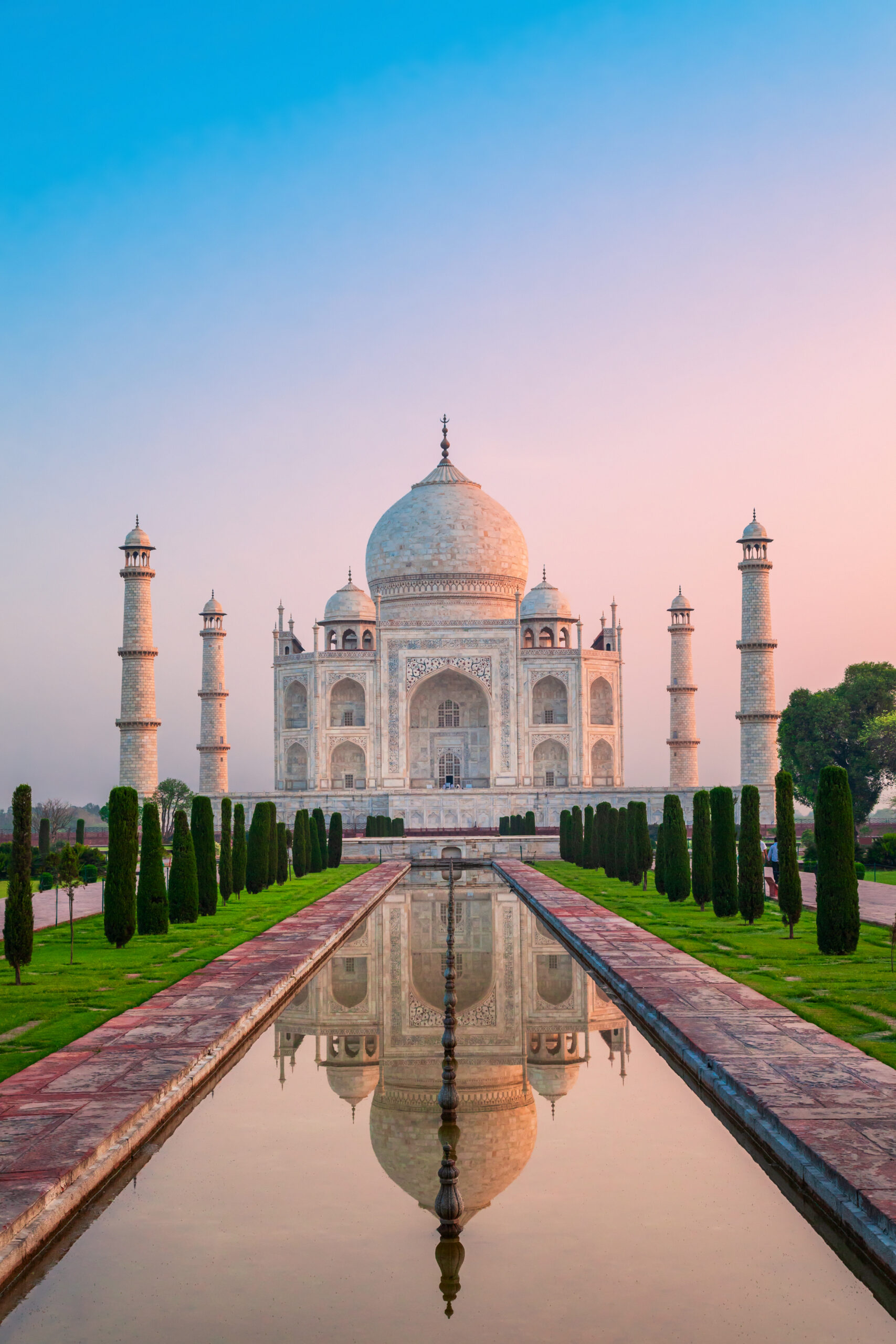
By 1630, the Mughals were ruled by a man named Shah Jahan and his wife Mumtaz Mahal. In 1631 the couple were expecting the birth of their 14th child, but after 30 hours of labour Mumtaz died, likely from a postpartum haemorrhage. The grief-stricken Shah ordered the construction of a tomb made of magnificent white marble 73 metres high, set in 42 acres of immaculate gardens. A tomb known as the Taj Mahal.
Two decades later, their son took the throne of the Mughals. His name was Aurangzeb. Under his rule the Mughal Empire unified almost all the Indian subcontinent and presided over the largest economy on the planet. The Mughals built roads and ships, mined diamonds, manufactured textiles and more.
With the expansion of the Mughals, the East India Company also prospered. It used its private army and navy to outcompete other European merchants.
But in 1707, Aurangzeb died, and the Mughal Empire began to fracture. Another invader swept in from Persia in the northwest. Once again the powerful cities of the North Indian Plain splintered. In this fracture the East India Company saw its great opportunity.
It moved quickly against its French rival and fought a series of wars up and down the east coast of India. Cannon fire echoed from huge ships and slammed into stone forts.
Eventually, the French were defeated.
The Company now turned its attention to the fragmented Indian states. It used money and influence to turn local rivals against each other, which undermined the strength and size of armed resistance to its private military.
In 1757, a Company army of around 3000 men under the command of a man named Robert Clive faced a much larger Indian army near a village called Palashi. The Indian force numbered around 50,000 soldiers, including 40 cannons and 10 war elephants, as well as French reinforcements. The outcome of this battle would determine control of the rich state of Bengal.
After some initial cannon fire, the British retreated to a grove of mango trees. The Indian army advanced, but at that crucial moment, a torrential monsoon rain began. The British quickly protected their gunpowder with tarpaulins, but crucially, the Indians did not.
The Indian general, named Mir Madan Khan, knew the rain put his own cannons out of action. He mistakenly assumed it had done the same to the British. And so with his cavalry, he charged. But the British cannons fired an enormous volley. The general was killed, and his army was defeated.
Seven years later, the East India Company won another crucial victory at the Battle of Buxar. The vast wealth of India now lay before them.
Over the next decades, the East India Company fought numerous small wars amongst the fractured Indian states. By the mid 1800s the Company ruled most of the subcontinent.
At its peak the East India Company commanded a quarter of a million soldiers, most of whom were local recruits known as sepoys. But over decades, tensions between the Hindu and Muslim sepoys and their British commanders grew. At the same time, tension also grew between the immense power of the Company and the British government in London. This growing tension would soon ignite.
In the 1850s, the Company began to issue a rifle called the Enfield. To load this rifle, soldiers opened a greased paper cartridge with their teeth, poured gunpowder from the cartridge into the barrel, and then rammed down a bullet. In 1857, rumours began among the sepoys that the grease used on these cartridges came from cows and pigs. Cows are sacred to Hindus, and Muslims are forbidden from consuming pork.
Against the background of long-rising religious and social tensions, the effect of these rumours was massive. Sepoys in a garrison near Delhi refused their cartridges and turned on the East India Company. But what started as a mutiny quickly became a much wider uprising against Company rule. Violence spread throughout the North Indian Plain and into central India. The death toll is estimated to be hundreds of thousands.
In the aftermath, the East India Company was dissolved and the British Crown under Queen Victoria took control of all its possessions. This established the direct British rule of India, which was known as the Raj.
The Raj lasted almost a century. In this time India’s economy and technology became entwined with the United Kingdom. Under British rule, it also experienced huge famines, some of the worst in human history. Nationalism strengthened, especially after the First World War, which weakened the British state. The drive for independence gained momentum under the leadership of figures such as Mahatma Ghandi.
At the same time, the ability of the British government to maintain a vast empire eroded. In 1947, in the aftermath of the Second World War, British rule began to collapse. In London, the Parliament passed legislation that partitioned India into two independent states – the Union of India, which was majority Hindu, and the Dominion of Pakistan, which was majority Muslim. Andp with that, British rule abruptly came to an end.
What followed was perhaps the largest single migration in human history. In the provinces of Punjab in the west and Bengal in the east, as many as 20 million people were displaced along religious lines, as Hindus and Muslims crossed the new borders. Violence spread, and while the death toll is not known, it is possible that as many as 2 million people lost their lives.
The new democratic states of India and Pakistan quickly went to war over disputed territory, which remained unresolved. In 1948, amid religious and political tensions, Ghandi was assassinated. But in 1950 an independent India ratified its constitution. It declared itself a democracy, and became the Republic of India.
War broke out again with Pakistan in 1965, and yet again in 1971, which resulted in an Indian victory and the independence of East Pakistan, which became Bangladesh. But in this time, India also suffered a defeat at the hands of the Chinese, again over disputed borders in the Himalayas. Outside the subcontinent, India remained neutral, and maintained relations with both sides during the Cold War.
But despite these tensions and armed conflicts, as well as many internal political and social challenges, India remained the world’s largest democracy – a title it retains to this day.
So we arrive in modern India; a country that is home to more than 1.4 billion people, nearly 20 per cent of all humans alive today.
The history of India is long and complex. But there are three broad trends we can see in the history we’ve discussed in this episode that continue to shape the country today.
The first trend comes from the high carrying capacity of the Indian subcontinent. Thanks to its wide rivers and deep alluvial soil, these lands have long supported one of the largest human populations on Earth. For most of history, this has meant that the economy of the subcontinent has been either the largest or the second-largest in the world, rivalled only by China, as we discussed in an earlier episode.
From the time of its trade with the Romans, through the classical age, the rise and fall of the Delhi Sultanate and the Mughal Empire, the lands of India accounted for up to a quarter of the entire global economy. Under the Mughals, as the East India Company began to establish its foothold, India accounted for about 28 per cent of global industrial output, surpassing even China.
But after the fall of the Mughals and the establishment of British dominance, India’s share of the global economy began to fall. By 1950, the new Republic of India accounted for just 4 per cent of global gross domestic product, which measures the total value of a country’s goods and services. Even today, India’s share of global GDP remains around 4 per cent. Viewed against the history we’ve discussed in this episode, this is an unusual low.
The second trend is a long history of political fragmentation on the Indian subcontinent, with relatively short periods of unification. From the time of the first kingdoms on the North Indian Plain, the political gravity of the subcontinent has pulled its people apart. The great empires of the Maurya, Gupta, the Delhi Sultanate, and the Mughals came and went within only a few generations. Almost none lasted more than a few hundred years.
This can be contrasted to China, a country with an equally large population, whose history can be described as long periods of political unification followed by relatively short periods of division, as we discussed in an earlier episode.
The reasons why Indian empires tend to fragment relatively quickly are subject to much debate. One explanation perhaps lies in the extraordinary diversity of India’s enormous population. Since ancient times, many different groups of people have crossed the Indus River and arrived in the fertile lands of India. And so the people living on the sub-continent have long spoken hundreds of different languages across several major language families. Authority has long been decentralised. For example, the many religions of India, especially Hinduism, never unified under a single authority in a way that could strengthen imperial rule, as the Christian church did for the monarchs of Europe, or Confucianism for the emperors of ancient China.
India remains one of the most genetically, culturally and religiously diverse places on Earth. In such diversity and decentralisation, it has proven difficult to establish lasting central authority.
This pattern of fragmentation means that in all the history we’ve discussed in this episode, no Indian empire of the past, from the Maurya to the Mughals, has ever expanded far beyond the subcontinent or over the oceans around it, even as Indian religion, culture, and philosophy spread around the world.
The third trend is the contrast between the power of India when it is united, and its weakness when divided. At its times of unification, the rulers of India were some of the most powerful on the planet, as the armies of Alexander the Great and Genghis Khan discovered so long ago.
But when India is divided, as it was for so much of its history, it lies open to invasion, especially from the north-west. From the armies of Mohammed Khuri and Timur to the merchants of the East India Company, a divided India is vulnerable to those who wish to conquer it.
So what does this all mean for the future of India?
First, since independence, Indian power has been focused on its contested and vulnerable northern borders. India has fought numerous wars with Pakistan, and fighting still occasionally erupts in disputed territories such as Kashmir. India has also fought and lost a war with China, and even today, Indian and Chinese troops face off across the high passes of the Himalayas.
In the immediate future, these tensions will likely continue. In particular, the rising power of China now allows its military to reach deeper into the Himalayas, in ways it never has before. One flashpoint is the disputed territory of Arunachal Pradesh, in the northeast, and another lies in the high plateaus of the far northwest. Tension also continues between India and Pakistan.
Second, as we have seen, India has immense potential. For most of human history it has accounted for around a quarter of the world’s economy. But today, it only accounts for around 4 per cent.
Yet there are signs this is starting to change. Since independence the economy of India has grown, and in the past few decades, this growth has accelerated. At the turn of the millennium, the Indian economy was the 13th largest in the world, comparable to South Korea or the Netherlands. Ten years later, it was the 9th largest economy, and today, by some estimates, it is the fourth largest, roughly equal to Japan.
India is now the fastest growing major economy on the planet. If this trend continues, India will soon surpass Germany to become the world’s third largest economy, behind only China and the United States.
As its economy grows, India is also spending more on its armed forces. It now has the world’s fifth largest military budget. India is purchasing fighter aircraft, submarines, drones and many other advanced capabilities. It is also one of the few countries to wield nuclear weapons.
And so, over the rest of the 21st century, India may continue to strengthen. The changes we are now witnessing may be the beginning of India’s return as a global superpower. This would shift the entire balance of world power, as the rise of China has done over the past few decades. The great decisions of the future may be made in Washington, Beijing, and New Delhi.
In the future, India may also begin to project power beyond the subcontinent in ways it never has before. India’s long coastline grants uncontested access to the open ocean, and so it is not difficult to imagine the power of the Indian navy one day rivalling that of China or even the United States.
Yet there remains a third possibility. As we have seen, India has a long history of fragmentation. The same faultlines that have caused ruptures throughout history, the powerful gravity that has long drawn India apart, still exists in Indian society today.
If India fractures again, then there is no telling what its future might hold. But if India remains a united democracy, then it will continue to rise as the world’s next great superpower.
Thank you for listening to A History of the Future. If you enjoyed this episode, please share it with your friends and colleagues, or leave us a review. And if you want to see more episodes like it, let us know via the Yaffa Media website.
Goodbye, and thank you again for listening.