
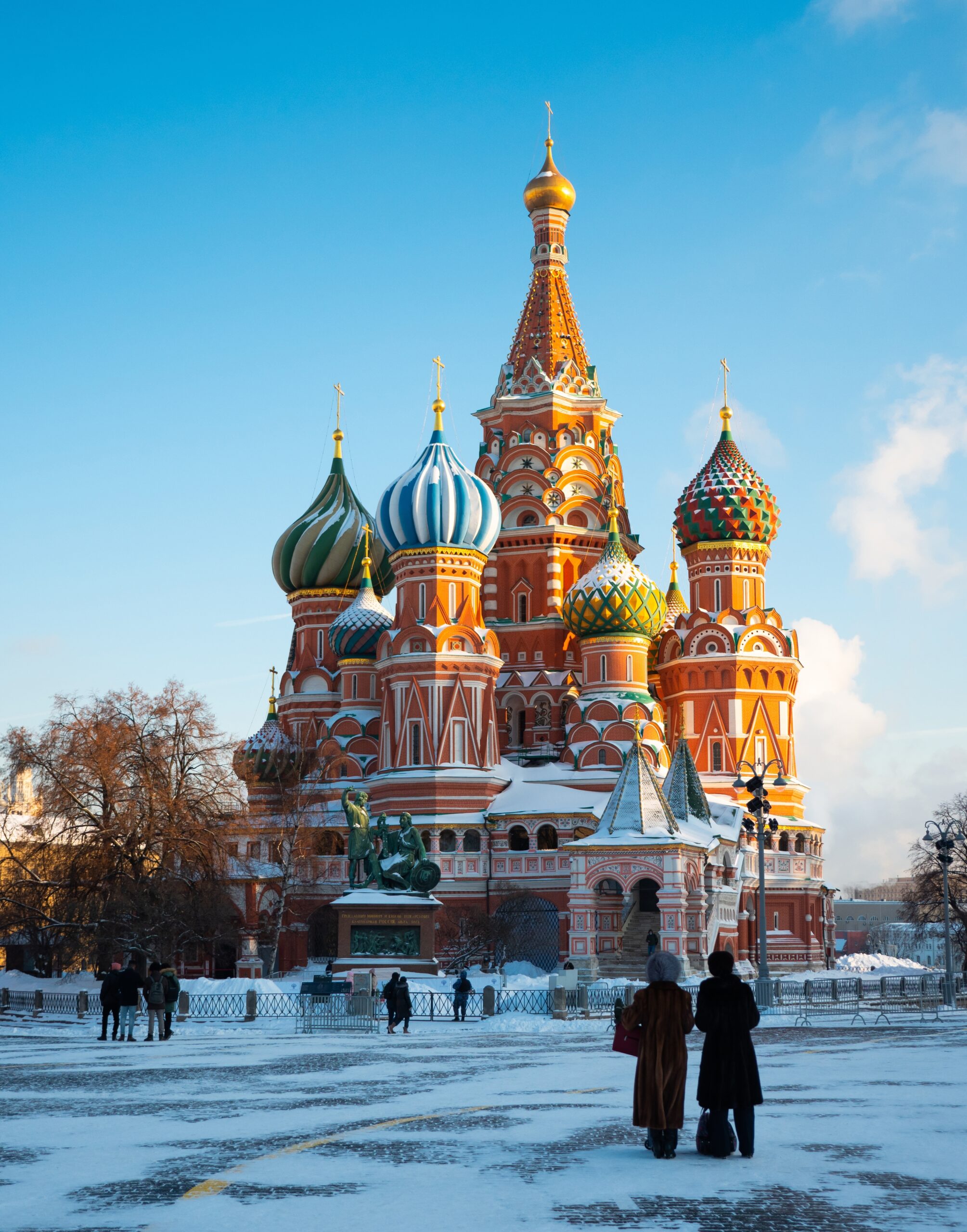
The cold, vast plains of Eastern Europe bear witness to a dark and ancient history.
In this episode, Ewen tells the story of Russia. Hear the sounds of ancient contests between settled people of the riverlands and the fierce, horse-riding nomads of the open steppe. Learn of the rise and fall of kingdoms amid the waterways and deep forests of the Russian heartlands. Discover Russia’s long history of imperial triumphs and violent invasions, of kings and revolutions, of war and peace; and enter the eye of the Kremlin, as its gaze looks west.
How has Russia’s geography and ancient past shaped the country today? What motivates Russia’s powerful and often tyrannical leaders? And what will happen when Vladimir Putin falls at last?
Play the Episode:
Episode Script
It is winter in Zubstov, Russia. This is a small town hidden from the world by tall, frosty trees. It is an unremarkable place; narrow dirt lanes potted by frozen puddles, triangular wooden cottages covered in a layer of thick snow, all spread along the banks of a shallow, icy river.
The land around is flat and white. It is quiet here, the sort of silence that only comes in the deep of winter, although it is broken every so often by the sound of engines.
The sound comes from the M-9, a road that bridges the river in Zubstov before continuing to the smoggy outer suburbs of Moscow, two and a half hours east. In the other direction, the M-9 leads to the Latvian border, a five-hour drive west.
It is a flat and featureless journey, mostly through dark forests, although at times the two-lane road runs past open white meadows before the trees close in again.
There are three things that stand out about the drive from Moscow to the Russian border on the M-9. The first is that it is flat. The second is that it is long. The third is that, in winter, it is also brutally cold.
Any explanation of Russia, any attempt to understand this country and why it does what it does, must begin with these three things. Russia is flat, it is large, and it is cold. These are the defining characteristics of Russia’s geography; and Russia’s geography is the foundation of how the country views and interacts with the world. It has shaped Russian history and implanted itself in the psyche of Russian leaders.
My name’s Ewen Levick, and you’re listening to A History of the Future. Each episode I look at a country making headlines today, and go down into the history behind the news. I want to start at the beginning and ask, why do countries behave the way they do? What motivates them? What are their greatest needs? And what do they fear the most?
In this episode, I want to show how Russia’s geography and history have impacted the modern world. I want to get into the minds of Russian leaders and show how they hold power. I want to ask, why does Russia behave the way it does? How do Russian leaders see the world around them? What do they fear the most? And after the terrible and ongoing invasion of Ukraine, where will the gaze of the Kremlin fall next?
The story of the state we know today as Russia begins in the earth beneath it.
Three billion years ago – about two thirds of the entire lifetime of our planet – an island called Baltica formed. Over billions of years this island drifted northward and became wedged into what is now the Eurasian continent. But remarkably, the igneous and metamorphic rocks that form the core of this tectonic plate changed very little.
This area is now one of the oldest and most stable tectonic plates on Earth. It is known today as the East European Plain. The Plain is a huge area of about four million square kilometres and, partly thanks to its great age, it is entirely free of mountains. With an average altitude of just 170 metres, it includes areas of very fertile soil known as Black Earth, and is criss-crossed by several major river systems.
The Plain is also located at high latitudes, mostly north of the 50th parallel, which reduces solar radiation, and the absence of mountains to the north or a nearby warm ocean current mean the Plain is exposed to cold polar weather systems and large seasonal fluctuations in temperature. This continental climate means hot, humid summers and severely cold winters.
Cold air cannot hold much moisture, and after dropping rain and snow in the northern taiga forests, almost no water is left in the weather systems that reach the southern part of the plain. Trees cannot grow, and so a wide grassland called the steppe dominates the landscape, which in the distant past, supported large herds of grazing animals such as aurochs, the extinct ancestor of modern cattle, and wild horses.
Around 45,000 years ago, modern humans first arrived in this area and began pushing out earlier species of hominids such as Neanderthals and Denisovans. By around 4000 BC, just as the Bronze Age began and the first forms of writing were emerging in Mesopotamia, these peoples lived as nomadic or semi-nomadic herders, constantly moving grazing livestock to fresh pastures primarily around the lower reaches of the Dnieper (NEE-PUH) river.
These tribes are known as the Yamnaya people, named in Russian for the way they buried their dead. Modern genetic studies have shown that these nomadic people underwent a huge expansion from the steppe and across Europe and South Asia around the third millennium BC.
There have long been different theories to explain this huge expansion of the Yamnaya. One of the most prominent relies on an interaction between the people of the steppe grasslands of southern Russia and a grazing animal that would go on to become central to human agriculture, warfare and trade – the horse.
The exact location and date for the domestication of wild horses have long been disputed. Yet a recent study of horse genomes across Eurasia showed a common ancestor in the Volga-Don region of modern Russia, the same lands as those of the Yamnaya. The same genetic study showed these horses were selectively bred to become more docile, more resilient to stress, and to carry a greater load on their backs.
It has long been theorised that the spread of the Yamnaya people was driven by the domestication of the horse, which along with the innovation of the wheeled wagon, greatly improved the mobility of these nomadic tribes. On foot, a herder might travel 20 or 30 kilometres in a day, but on horseback a herder might travel up to 100 kilometres.
Horses with stronger, healthier spines were able to carry heavier loads across greater distances, facilitating trade and communication between Bronze Age cultures. The tribes were now able to have larger herds of livestock and move them further and more frequently. Larger herds meant more food and a larger human population. Studies even show the genes of the Yamnaya people reaching as far west as Ireland by around 2000 BC.
However, other research shows that the spread of the domesticated horse came after the Yamnaya migration. Instead, analysis of declining crop yields in western Europe around the time of the migration show that a climactic shift caused a huge decrease in the human population living to the west of the steppe. Fertile lands were left empty for hungry herds.
We may never know the true reason the Yamnaya spread so far – but the impact of this migration is still obvious today. Evidence for it lies even in the way I am speaking to you in this podcast. The Yamnaya were one of the first speakers of a language that modern linguists call Proto-Indo-European, which spread with the Yamnaya through Europe and across to northern India.
This is widely accepted to be the common ancestor of the entire Indo-European language family, which includes English, Russian, Spanish, French, and many other modern European languages, as well as Hindi, Bengali, Punjabi and more. In fact, more than 40 per cent of people alive today are native speakers of a language that has its origins amongst these ancient nomadic tribes of the East European plain.
By 2000 BC, domesticated horses had spread across Eurasia. With them came new weapons, innovations such as the chariot, and increased competition for grazing lands, which fuelled new conquests and conflict.
And so the horse and chariot transformed Bronze Age societies across Eurasia. As we will see, the mobility that the horse provided the people living on the steppe grasslands of the East European tectonic plate established a pattern of repeated conquest that would shape later Russian history and the way its leaders look out at the world today.
By the 8th century BC, a new people arrived in the steppes to the north of the Black Sea. They came on sailing ships from a mountainous peninsula far to the south. These people were the Greeks.
Partly driven by a search for new agricultural lands, the Greeks found the fertile Black Earth soils of the East European plain, on what is today the southern coast of Ukraine. Colonies were established and trade routes began across the Black Sea, through the Bosporus and south to the Greek mainland. Ships carried grain to Athens and other city-states, along with slaves, who were valuable to agriculture and other industries in ancient Greece.
The deep waters of the Black Sea contain very little oxygen, and so shipwrecks on the sea floor are remarkably well preserved. The oldest intact shipwreck on Earth is found here; a Greek merchant vessel dating to 400 BC, its hold of cargo still perfectly sealed and unknown.
Over the next few hundred years, control of this area of fertile soil fell largely under independent Greek kingdoms such as the Bosporan Kingdom and the Kingdom of Pontus. But by the first century BC, the Greek colonies were swallowed into one of the largest empires in history – Rome.
Under Roman rule, the southern reaches of the East European plain were now the frontier between the centralised, settled civilisation of the Empire and the nomadic people of the grasslands whom the Romans called Scythians.
This was a violent, uncertain frontier. Ancient sources describe foreign aggressors, perhaps relying on their skill with horses, often pouring destructively across the Roman border.
While the reliability of these sources is not certain, what is known is that the dominant nomadic group of these grasslands shifted often in what is now called the Migration Period. But one group was to emerge that would hasten the end of Rome itself.
Around 370 AD, a new tribe of nomadic people migrated from the lands that lie to the east of the Volga, one of the largest rivers draining the East European Plain in what is today Russia. As nomadic pastoralists, they were masters of riding horses, and their style of warfare was characterised by mounted archery. These people were called the Huns.
The mobility of the Huns allowed them to swiftly move westward into northern Europe, pushing out Germanic tribes such as the Goths and the Vandals. As these tribes fled into Roman territory to escape the Huns, sometimes in armed invasions of their own, in 395 AD the Empire itself split into a western and an eastern half. Fifteen years later, the city of Rome was sacked by the Visigoths, a Germanic tribe under the command of a man named Alaric. The Empire was fatally weakened.
Then, twenty years later, one man took control of the Huns whose name would go on to strike fear into the heart of Rome. His name was Attilla.
From the year 450 AD, Attilla pushed westward into the weakened Roman Empire. He captured cities in the province of Gaul, but was defeated by the Romans to the east of what is now Paris. Yet this was to be one of the last military victories the Roman Empire ever recorded. Attilla turned south and invaded Italy, and only two decades after his death in 453 AD, Rome fell at last.
The collapse of Roman civilisation took Europe into the Dark Ages. Christianity spread through the tribal people living across the continent.
During this time, as we covered in an earlier episode, the Imperial period in China led to the development of numerous technologies and the spread of trade throughout Asia. In India, the classical period saw a huge economic and cultural boom. In Africa, the introduction of the camel and trans-Saharan trade laid the foundations for the rise of the Ghanian Empire. And in South America, the Moche civilisation flourished in northern Peru.
Meanwhile, the people of the East European plain continued to live a nomadic or semi-nomadic life, largely under the banner of the Khazars, a confederation of Turkic speaking people.
Then, by around 850 AD, a recently Christianised people speaking an Indo-European language became the dominant group in the Plain. They were called the Slavs.
The Slavs spread along the major river systems of the Dnieper and the Volga and established the settlement of Novgorod, which lies south of modern St Petersburg.
Around the same time, the Vikings used their shallow draft longships to cross the Baltic Sea from Scandinavia and push down the wide rivers of the East European Plain.
According to the Primary Chronicle, a book of questionable historic reliability written by a monk around the year 1110, the interaction between the Vikings coming the north and the Slavs moving from the west and the south first lead to a unified kingdom sometime in the late 9th century AD. This kingdom was called Kievan Rus’ and it was first unified by a man called Oleg.
Oleg’s father was named Rurik, and it is this name which carried on after Oleg as the Rurikid dynasty. This family ruled the region until the late Middle Ages. Yet it was under the succession of Rurikid kings that followed in the 10th and 11th centuries that the kingdom of Kievan Rus’ expanded to cover the flat lands west of the Ural Mountains.
The origin of the name Rus’ is disputed, but it is perhaps derived from an Old Norse term meaning ‘men who row’; a reference to how the people of the Plain navigated the many river systems that wind their way across these lands. Over the next centuries this word “Rus’” evolved through the languages of Byzantine Greek and Medieval Latin to become the word we use in English today – Russia.
According to the Primary Chronicle, Christianity was firmly established in Kievan Rus’ with the baptism of its ruler Vladimir the Great in 988 AD. In this time, this new Russian kingdom prospered. Its economy was based on the supply of fur, beeswax, honey, and slaves, as well as its location on important trade routes between Europe, the Middle East and Asia.
Yet as a result of the vast, ancient and flat geography of the East European tectonic plate, the Russian lands had no strong natural borders, and they were in frequent conflict with nomadic tribes of the steppes, such as the Khazars, and occasionally with the powerful Byzantine Empire on the far shores of the Black Sea.
As we will see, this state of conflict and geographic openness, particularly between the settled, fortified cities of the Russians and the nomadic, horse-rearing cultures of the steppe, would go on to shape the way Russian leaders look out at the world around them.
The Kingdom of Kievan Rus’ reached its greatest extent during the reign of Yaroslav the Wise, who died in 1054 AD. On his death, his kingdom stretched from the Baltic Sea in the north to the Black Sea in the south.
Yet at the same time, there was a fundamental weakness. The Rurikid dynasty failed to institute a clear succession upon the death of a ruler. And so, after the death of Yaroslav, infighting and assassinations weakened the Russian kingdom.
Over the next century, the power of the Byzantine capital of Constantinople also weakened, and with it trade through the lands of the Russians faltered and the economy fell.
But it was a new threat from far to the east that would finally see the kingdom of the Kievan Rus’ end in fire and flame.
Its origins can be traced to those very same Russian lands, thousands of years before the spread of the Slavic people; a threat that began with the domestication of the horse.
Sometime in the early 1220s, an unnamed Russian villager must have been the first to see mysterious warriors riding on horseback through the dark pine forests on the kingdom’s eastern border.
That villager, whoever they were, could not know that they would be history’s silent witness to the end of their world; for the riders they saw in the forest were the Mongols.
By the year 2000 BC, horses had become central to the lives of the nomadic people living in the steppes to the south and east of what later became the Slavic heartlands. It is said that amongst these nomadic people, children could ride before they could walk, and they certainly grew up to become highly skilled horse archers.
Since the time of the ancient Greek colonies on the southern edge of the East European Plain, settled people found the nomadic horse archers of the steppe extraordinarily difficult to fight. From the Scythians to the Huns, the horse archer was the apex predator of ancient warfare, against whom even the famed Roman legions struggled.
The reason for this was the combination of the weight and mobility of the horse along with the composite bows the nomads used. These bows combined wood, bone, sinew and leather into a weapon that could shoot a killing arrow over 300 metres. This is the effective range of a modern assault rifle firing NATO-standard 5.56-millimetre ammunition.
Armies of horse archers could also move dozens of kilometres further each day than armies containing infantry, and from the blood and milk of their own horses they were better able to live off the land. At the time, the horse archer was, quite simply, the single most lethal thing on Earth.
Some time between 1150 and 1167 AD, not long after the kingdom of Kievan Rus’ entered its decline, a boy was born near the Onon river in the east of what is today Mongolia. He was named Temujin.
At just eight years old, Temujin’s father was murdered and his mother exiled into the harsh Siberian wilderness along with her children and older step-children. Against all odds, this mother, Hoelun, kept her family alive on roots and nuts, fish and small animals.
From this harsh and extremely remote beginning, Temujin went on to rise through the ranks of the steppe tribes. He suffered setbacks and may have spent almost a decade in the service of the Chinese emperor before returning to the open grasslands of Mongolia.
By the age of around 40, or perhaps a little older, Temujin defeated his rivals and became the sole ruler of the steppe tribes. His eventual victory would forever change the course of history.
Temujin convened an assembly at the source of the Onon river, his birthplace, and gave himself the name Chinggis Khan. This name entered English from Persian sources as Genghis.
Genghis Khan then reorganised the entire Mongol social and military hierarchy to ensure unwavering loyalty to him and him alone. These reforms were remarkably effective. Genghis now commanded a huge army of well-organised and lethal horse archers. He turned the Mongols into the single most powerful group on the planet.
From the age of around 50, Genghis Khan began a series of invasions throughout the Eurasian landmass that burned through civilisations like a wildfire.
In the 1220s, the Mongols reached the lands of the Slavic people and drew them into battle on the Kalka river in what is today eastern Ukraine. The army of the Russians and much of the aristocracy was annihilated, but as quickly as they had appeared, the Mongols vanished.
Then, in the depths of the winter of 1237, a decade after the death of Genghis Khan, the Mongols returned. The vast rivers of the Volga and Dnieper were frozen, and so the armies of horse archers were able to move quickly over the frozen water. They easily encircled and massacred Russian forces sent to oppose them.
When they came to Russian cities, the Mongols used new incendiary weapons from China to end sieges brutally and quickly.
In just three years, they had conquered all the major cities of the Slavic people.
The Mongol invasions were so enormous in their scale and sheer destruction that the global death toll was not surpassed until World War 2. The Mongol conquests are estimated to have killed 11 per cent of all humans alive at the time – more than one out of every ten people on Earth. This means, in relative terms, the conquests remain the deadliest conflict in all human history. The return of forests to the farmlands the Mongols destroyed even lowered atmospheric carbon dioxide levels and caused the temperature of the entire planet to drop.
After the Mongol devastation in the lands of the Russian people, famine spread. According to the Novgorod Chronicle, which dates to the late 1200s, people resorted to eating horses, dogs, moss, tree leaves, and even the bodies of the dead. In the ruins of burned settlements, human bones littered the earth.
From this apocalyptic destruction, Russian cities would take more than a century to rebuild, and as we will see, the scars of this invasion would never truly leave the Russian psyche.
Russia’s Rurikid dynasty survived the fall of Kievan Rus’, but its leaders remained under the control of the Mongols well into the later medieval era, under the khaganate known as the Golden Horde.
By this time, Catholic Christendom had split in two. The Russian people followed the eastern Orthodox church and their religion diverged from the authority of the Pope, who held sway in western Europe.
In the 13th and 14th centuries, the rulers of the Russian people slowly gained greater autonomy even as they paid tribute to the Mongol Khans. The destruction of older Slavic cities in the Mongol invasion meant new settlements rose to prominence amongst the Russian principalities.
Foremost amongst these were the cities of Nizhny Novgorod, Tver, and Moscow.
The city of Moscow in particular sits in an advantageous position. It is on the banks of the Moskva river, which through its tributaries connect the city to major inland waterways such as the Volga, facilitating trade and creating protective natural borders.
The rulers of the city, soon known as the Grand Principality of Moscow, initially cooperated with the Khans. Eventually, in the 15th century, under the rule of the Rurikid prince Ivan the Third, the Grand Principality annexed the rival cities of Novgorod and Tver and consolidated Russian lands into a centralised state. At the same time, the power of the Khans themselves eroded until conflict between the two began.
Ivan judged the time was now right to truly overthrow the rule of the Khans. In 1476 he refused to pay the customary tribute and conflict broke out with the Golden Horde. But the Horde fragmented soon afterwards. The Russian people now emerged as a unified political entity.
Many of the foundations of the modern country of Russia truly began under the rule of Ivan, who became known as Ivan the Great. Over his 43-year reign, he adopted the double headed eagle as the emblem of the Russian state, which remains today. He built the fortress of the Kremlin, which remains the seat of the Russian government. He also took on the Slavic title ‘tsar’, which derives from the Latin name ‘Caesar’ and means ‘king’ or even ‘emperor’, and he established the autocratic rule of Russia which continues to this day.
From the reign of Ivan the Great, the power of the Russian state grew under the absolute and sometimes tyrannical rule of the tsars. Through the 16th century, Russian territory expanded, but it was also subject to further invasions from the Swedes, the Poles, Lithuanians and the Crimean Tartars, who burned Moscow in 1571.
In the early 1600s, after 700 years and 21 generations, the Rurikid dynasty finally came to an end. Russia entered a period known as the Time of Troubles. Civil wars and foreign interventions, as well as unusually cold summers, caused famine and unrest. This period gave rise to a new dynasty, the Romanovs, who would go on to rule Russia for the next 300 years.
At first the Romanovs set about stabilising the country and regaining control of lost lands. They continued the expansion of the Russian state out of the East European Plain and into Siberia, subjugating the Indigenous people living there, and reached the Pacific Ocean in 1639.
Under the rule of Peter the Great, which began in 1682, Russia was the largest country in the world. Yet its territory brought significant disadvantages.
One of the most pressing was the lack of access to the open ocean. The few ice-free ports on the Russian coast opened onto seas controlled by other powers, such as the Swedes and the Turks.
After establishing the city of St Petersburg in 1703 on the Baltic Sea and defeating Sweden in 1721, Peter finally established Russian access to the ocean. He then proclaimed the advent of the Russian Empire.
At its height, the Empire ruled over a sixth of all the land on Earth. It colonised all of Siberia, the land now known as Alaska, and established colonial outposts in what is today California and Hawaii.
Russia was now a major European power with vast Asian and North American territories; but its heartland on the East European Plain remained open to invasion.
After the death of Catherine the Great in 1796, Russia was invaded by the French emperor Napoleon in 1801. The Russians burned their own lands and relied on the vast landscape of the East European Plain, and the brutality of its winter to defeat the French, whose army retreated from the edge of Moscow itself. Only one in 20 of Napoleon’s men is said to have survived.
At this time, the Industrial Revolution was well underway in western Europe and the newly independent United States. The power of European monarchs weakened and democratic systems strengthened. The industrial empires of Great Britain and France eclipsed the power of Russia and defeated the armies of the tsar in the Crimean War in the 1850s.
Despite this defeat, the Romanov dynasty remained the last absolute monarchy in Europe. This meant Russia was largely incapable of the transformational economic and bureaucratic reform necessary to keep up.
By the late 1800s Russia was economically, politically and technologically behind. Corruption and inefficiency took root. The crushing power of the tsars clashed with the need for reform and the liberalisation of European countries to the west. Russian society strained under this tension.
Military defeats soon followed. In 1905, Russia experienced a humiliating defeat at the hands of the Japanese and unrest began to spread in its cities. Repeated losses and high casualties in World War 1 were the last straw.
In 1917, the Russian Revolution led to the overthrow of the last Romanov tsar, Nicholas II. His whole family was executed and the Russian Civil War began.
This concluded in 1922 with the victory of a man named Lenin and his Bolshevik forces, who followed a revolutionary political ideology called communism. The Russian Empire became the Soviet Union.
Less than twenty years later, the Russian heartlands in the East European Plain were once again subject to a brutal invasion as the armies of Nazi Germany swept eastwards.
In terms of the overall loss of human life, the Eastern Front was the worst conflict in history. The Soviet armies once again relied on the vast distances and polar weather of the East European Plain, retreating eastwards to stretch out German supply lines.
Then, as German momentum slowed, the Russians fought back and eventually marched into Berlin. In their final victory, they suffered more casualties than any other country in the war. It’s estimated that 27 million Russians lost their lives. The scars are still evident in the memorials in Russian villages like Zubstov, and in the memories of many older Russians alive today who lost family members in what they call the ‘Great Patriotic War’.
The Soviet Union emerged from World War 2 as a superpower, and quickly entered competition with the only other superpower to rise from the ruins – the United States. Yet as powerful as the Soviet Union was at its height, it ultimately could not compete, and attempts at reform in the 1980s led to its collapse in 1991.
During these last years of the Cold War, a young man in his mid-twenties was deployed as an agent of the KGB, the Soviet security agency, to East Germany. This man had grown up in gang violence and poverty in Leningrad, which is now called St Petersburg. His grandmother had been killed by the Germans in 1941, his maternal uncles disappeared on the Eastern Front, his own brother died during the Siege of Leningrad in 1942, and his father was severely wounded in the same year. His name was Vladimir Putin.
Putin was in East Germany for the fall of the Berlin Wall in 1989, and so he witnessed firsthand the collapse of the state he worked to support. Distraught at the fall of the Soviet Union, Putin returned to Russia. He rose through the ranks of government to at last, at the turn of the millennium, become the modern version of a tsar – the President of the Russian Federation, a title he retains today.
So we come to the Russia of 2026; a country ruled by one man for almost 30 years, and a country once again at war.
There are a few trends from the Russian history we’ve discussed in this episode that continue to shape the country today and forecast its future.
The first trend is the vulnerability of the Russian heartlands to invasion. The vast, flat and cold expanse of the East European tectonic plate provides few natural borders to those who wish to conquer it. From the time of the Yamnaya through to the Romans, Scythians, Huns, Slavs, Mongols, the armies of Napoleon and then those of Hitler, over thousands of years the people living in the open country west of the Ural mountains have been extremely vulnerable to outside attack.
Many of these conquests were unrivalled in their brutality and cost in human lives. The Mongol invasions wiped many Russian cities from the map, and the invasions and eventual defeats of Napoleon and Nazi Germany also came at extraordinary cost to the Russian people. Famine and deep suffering always followed, often compounded by the absolute rule of Russia’s powerful leaders.
But whilst the vast, flat and cold landscape made the Russians vulnerable to invasion, it also provided their greatest defence. In the freezing vastness around villages like Zubstov and the M-9 motorway, we can see this second great trend of Russian history.
The calorie requirements of humans undertaking physical activity in the extreme cold varies inversely with temperature, rising to 7000 calories at -40 degrees Celsius; almost three times the average daily intake of a grown man. At such low temperatures, people can succumb to starvation twice as fast as they would otherwise. This dramatically increases pressure on military supply lines, which must also stretch across the great distances of Russia.
The cold also affects modern materials. Polypropylene plastics become weak and brittle at -20 degrees; at -40, oil freezes and batteries stop working; gasoline freezes at -60. Temperatures in Siberia regularly drop to below the average surface temperature of Mars, -63 degrees Celsius, which is low enough to shatter thermometers.
The effect of this cold on invading armies is devastating. During the Second World War, one witness in Poland saw soldiers returning from the Eastern Front with no eyelids – they had frozen and dropped off in the Russian cold. Gasoline froze inside engines, soup served boiling from the pot froze before it could be eaten, the recoil mechanisms on weapons froze solid, and hands froze onto metal.
Russia’s geography means that it is vulnerable. Yet this same geography has also allowed Russia to defeat invaders by trading territory for time, and waiting for winter.
This means that the size of Russia’s territory creates the country’s sense of security. A large territory means strength against invasion, and a shrinking territory means weakness. And so Russia has long engaged in a kind of defensive expansion; it always seeks to grow its land and influence, often through attacking others.
The same calculus also applies to Russia’s access to the open ocean. Even today, all major Russian ports that are not frozen in winter open onto seas controlled by either NATO nations or the Japanese. As an example, the Russian seizure of Crimea in 2014 was largely aimed at maintaining control of the port of Sevastopol, the home of its Black Sea fleet.
And so, war has been a nearly constant feature of Russian life for centuries. In the last 200 years, hardly a decade has passed without a war involving Russia. War, and the suffering it creates, are deeply embedded in Russian history, culture and memory.
The third trend we can see from Russia’s history is a pattern of strong autocratic rule. Since the centralisation of the Russian state under Ivan the Great, the Russian population has never lived under a truly democratic system. The tsars of the Russian Empire gave way to the General Secretaries of the Soviet Union, who in turn gave way to Vladimir Putin as the autocratic president of the Russian Federation.
In modern Russia, Putin holds power through what is known as a patron-client system. In this system, leaders or patrons promote and protect their clients to secure a debt of personal loyalty. Networks are reinforced through emotional and familial ties. Putin’s inner circle, for example, is composed of men who know him from childhood and through the KGB. These threads of loyalty extend downwards through innumerable networks to make a complex web.
But in this system, Putin must constantly signal his strength to retain the loyalty of those beneath him. A weak patron might be overthrown, but only through collective action; clients must first agree on a new patron, gather enough support, and agree on a time to switch their loyalty, all whilst keeping their own networks in check. Putin on the other hand, at the apex of Russian power, only needs to disrupt the process – potentially through a brutal public assassination – to retain his iron grip.
This helps explain the ruthless Russian political system. Many prominent Russians have been assassinated and murdered under the reign of Putin, because the Russian leader does not, or cannot, forgive those who challenge him.
So what does this long history mean for Russia’s future?
First, it means Russian leaders will always seek sufficient territory and influence to defend the vulnerable Russian heartland west of the Urals. From the conquests of Peter the Great to the rise of the Russian Empire and the global influence of the Soviet Union, Russia has long followed a strategy of defensive expansion.
Thanks to its size, population, and imperial history, Russia also sees itself as a great power.
But in reality, Russia is not a great power. Its ambition far exceeds its actual capabilities.
The Russian economy is roughly equivalent to those of Italy or Canada. Its population is shrinking. And its military has been hollowed out by years of corruption and defeats on the battlefield. And so Russia’s expansionist ambitions and vision of itself as a great power clash with the reality of its own weakness.
To get around this weakness, Russia seeks to undermine and destabilise more powerful opponents, especially the United States, without engaging in open conflict. It meddles in democratic elections, supports dictatorships abroad, and spreads misinformation. It uses mercenaries to gain control of resources, particularly in Africa. And it seeks to divide alliances such as NATO which it sees as a threat to its own security. Many headlines today reflect these efforts.
Russia also seeks relationships with other countries opposed to America’s global dominance. In recent years, it has become very close with North Korea, whose troops now fight in Ukraine. Most importantly, Russia seeks deeper ties with China. The Russian economy now relies heavily on sales of energy and resources to Beijing. But China is far more powerful than Russia, and so Moscow has found itself subservient.
Second, Russia’s long history of absolute autocracy means the country is unlikely to embark on true democratic reform in the foreseeable future. Since the 700-year reign of the Rurikid dynasty, Russian power has been centralised under the rule of a single person.
Today, powerful internal security forces and state-controlled media work together to retain control over the Russian population. Prominent Russians who disagree with the government are frequently murdered; many have been thrown from hotel windows in Moscow, India, and even Washington DC, whilst others have been shot or poisoned.
The actions of Russia today are decided by one man and one man alone. Vladimir Putin has now ruled over Russia for more than a quarter of a century. The entire power of the Russian state sits at his whim.
In Putin’s warped and badly informed view of the world, the collapse of the Soviet Union and the loss of its satellite states was a global tragedy. He yearns to restore Russian authority over the lands he believes it lost in 1991.
Yet Putin is growing older. He is now 73, in a country with a male life expectancy of around 70. During the pandemic he isolated himself within his own palatial estates for years. Any visitors had to first quarantine for two weeks under armed guard, and then pass through a tunnel of UV light and disinfectant to meet the paranoid Russian President.
In this state of isolation and increasing paranoia, Putin believes the West is out to overthrow Russia, and he has grown obsessed with his own legacy. And so, under Putin’s authority, the unprovoked and brutal Russian invasion of Ukraine continues, at the cost of hundreds of thousands of human lives.
In defence of its own existence, Ukraine has lost tens of thousands of its own people, and its population lives under near-constant Russian bombardment.
Yet this invasion has exposed Russia’s weakness. Despite large numerical advantages, recent estimates place the Russian advance at just 50 metres per day, slower than even the most static battles of World War 1.
Russia has suffered over a million casualties, lost thousands of armoured vehicles, much of its Black Sea naval fleet, and a huge amount of its air power. Against superior Ukrainian tactics and Western military equipment, Russian forces have brought poor command structures, poorly maintained equipment, and a callous disregard for the lives of their own men.
Looking out over the rest of the 21st century, Russia’s future is difficult to predict. What is clear is that the fate of this huge country rests on the health of Vladimir Putin himself, as it once did on the tsars who came before him. Putin knows this; he travels with a team of doctors and has publicly talked about extending his own lifespan.
For as long as Putin remains in control of Russia, it will continue to be an expansionist and subversive power. If Putin successfully divides western alliances such as NATO, he may try and seize other former Soviet territories on the East European Plain, especially in the modern nations of Moldova, Estonia, Latvia, Lithuania, or Poland. Many headlines today come from Russian threats to these countries, whose security rests on their military alliances with the United States.
But despite his best efforts, one battle Putin cannot win is his fight against time. Eventually he will lose control of Russia – perhaps within the next decade. If he does not develop severe cognitive impairment or sudden physical decline, he may have 15 or even 20 years left. But his time will one day run out.
Nobody truly knows what will happen after he is gone. Finding out is a major focus of Western intelligence agencies. If Putin does not name a viable successor, what is likely within the next decade or two is a power struggle emerging amongst the Russian elite, especially those with the loyalty of the military or their own private mercenary forces. This struggle could easily erupt into open violence or at worst, civil war.
But until the day Putin finally falls from power, conflict between Russia and the countries around it will almost certainly continue.
Thank you for listening to A History of the Future. If you enjoyed this episode, please share it with your friends and colleagues, or leave us a review. And if you want to see more episodes like it, let us know via the Yaffa Media website.
Goodbye, and thank you again for listening.